


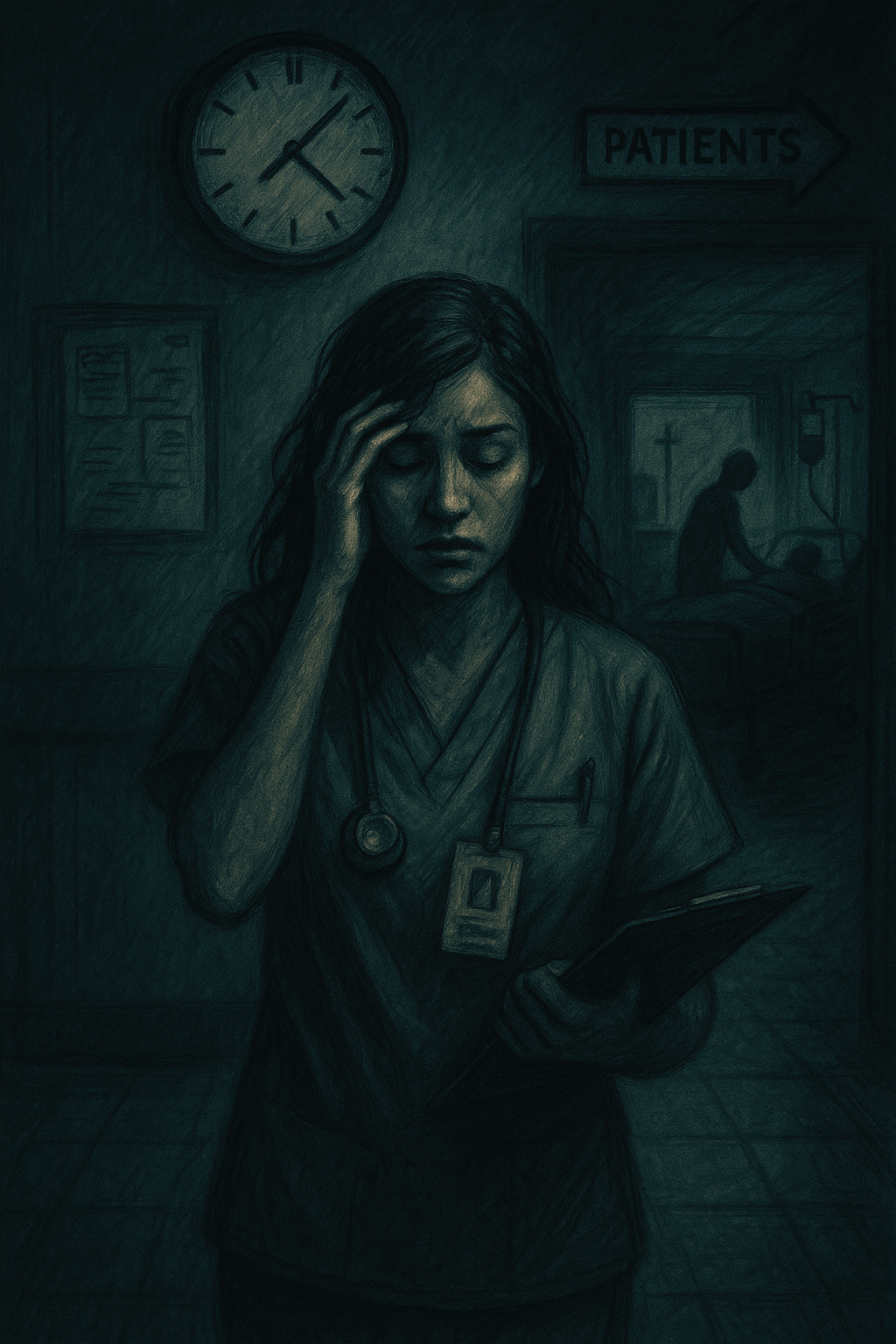
The Quiet Aftershock
They say trauma comes in waves, but mine struck like lightning- sudden, disorienting, and irreversible.
One moment, I was a nurse responding to a patient. Next, I was the patient.
I was assaulted on the job – physically attacked by someone I was trying to help, repeatedly struck in the head. It wasn’t cinematic. There was no dramatic slow-motion scene, no scream, no drawn-out struggle for survival. It was quick, brutal, and horribly ordinary. I didn’t lose consciousness, but in that moment, I lost so much more.
When the medical response team rushed in, they asked, “Who’s the assigned nurse?”
I stared at them blankly. My vision blurred. My brain scrambled for an answer. I looked around the room, trying to process the question, but nothing made sense to me. I didn’t even realize they were talking about me, a red flag I didn’t recognize at the time.
Instead of being treated, I was processed. I received an estimated fifteen minutes of “care” in the ER: a brief check of my pupils, a few orientation questions, an offer of Motrin, an ice pack, and then I was dismissed.
It felt mechanical, like an assembly line. One injury. One nurse. In. Out. Done.
I left that hospital with nothing but a fogged brain, a pounding headache, and an overwhelming sense that something was terribly wrong. The doctor didn’t bother with scans – not that it would have mattered. Concussions often don’t show up on imaging. That’s part of what makes them so easy to dismiss.
But I couldn’t dismiss it. And neither could my body.
I remember walking out of the hospital, still in my scrubs, head spinning. The air felt too thick. My legs felt too heavy. Getting into my car was a monumental effort. The seatbelt felt too tight, the world outside too bright, the radio too loud. I turned it off, but the silence was worse.
My hands gripped the steering wheel, but the road ahead seemed to stretch endlessly. My usual route home was now a blur of distorted images. Every street sign was more blurred than the last. My pulse raced. My head throbbed.
What was happening to me?
I should have known. The signs, the symptoms, the pain, they were all there. But no one told me how deep this would go. No one warned me about the unseen battles: isolation, disbelief, and exhaustion.
I gripped the wheel tighter, trying to focus, whispering to myself:
You’re fine. Just breathe. Get home. Rest.
But the truth was more complicated. I didn’t know how to fix what I didn’t know was broken. And I had no idea how long it would take to feel whole again.
This wasn’t just about the assault. It was about everything it set into motion the slow unraveling, the suffocating lack of information, the breakdown of everything I thought I understood about my life.
It wasn’t just the headache, the dizziness, or the confusion. It was the sensation that something fundamental had shifted, the haunting feeling that nothing would ever be the same again.
Outside the car, the world continued to spin.
Inside, everything slowed to a crawl.
And that silence was more deafening than anything I could have imagined.

Leave a Reply