
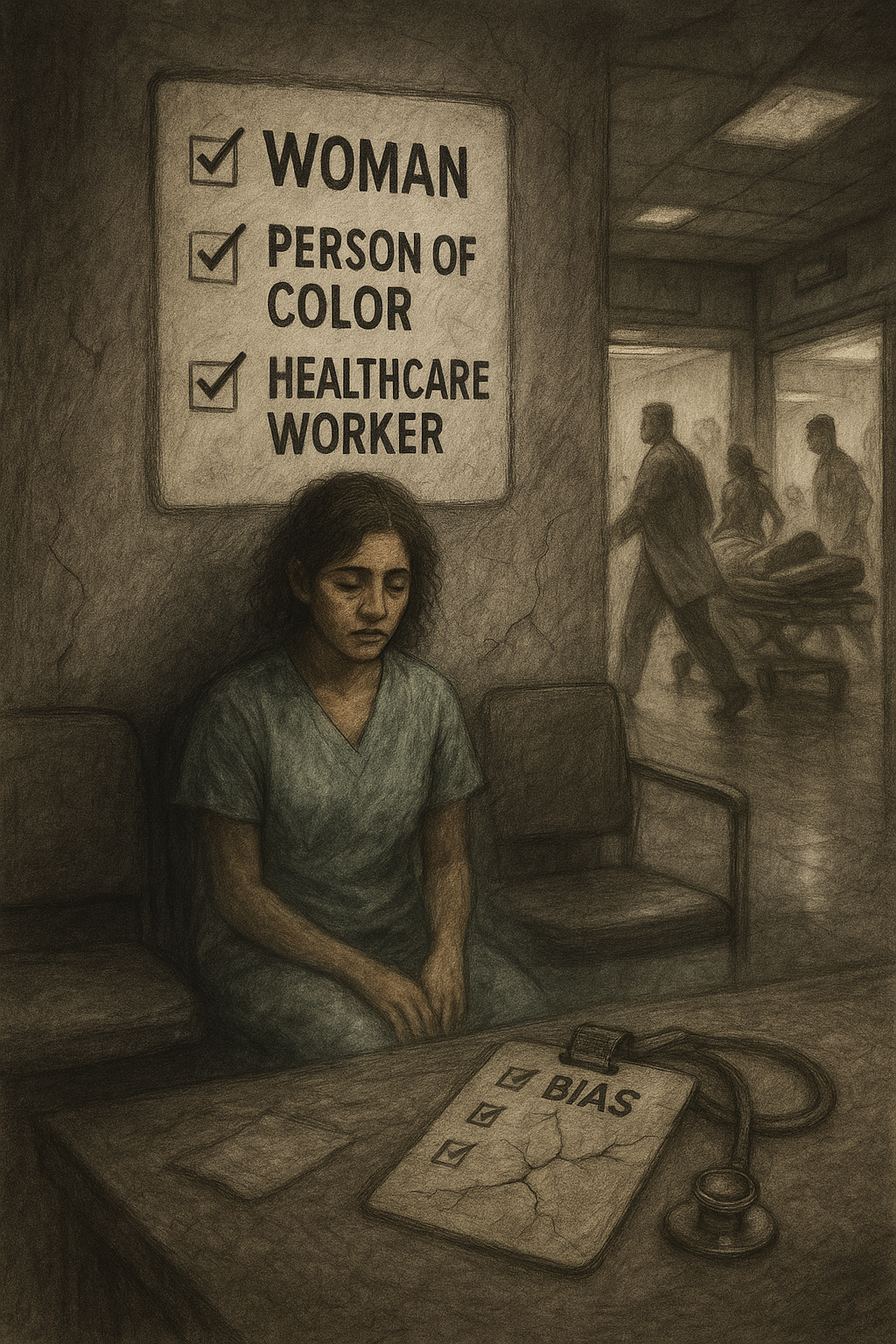
The Perfect Trifecta
What do a woman, a Hispanic, and a healthcare worker have in common?
As I would painfully learn, they all get overlooked in the emergency department.
Fast forward eight months from my assault. I was deep into research, obsessing over four questions:
- What went wrong?
- Why is it bad?
- How was this allowed to happen?
- And how could it have been prevented?
Even the dreaded question leadership loves to ask echoed in my mind: What could I have done differently?
One evening, I was reading aloud to my husband, trying to make sense of everything, when the realization hit us – a dark, bitter joke hiding beneath the data.
Far too often, especially in high-pressure ER settings, patients who don’t “look” injured are brushed off. This is particularly true for women, healthcare workers, and people of color. If the trauma isn’t visible, the default response tends to be disbelief.
My husband burst out laughing.
“You’re the perfect trifecta,” he said, still chuckling. “The walking Bermuda Triangle.”
I rolled my eyes. “Thanks.”
“No, really,” he continued, teasing. “A woman. A person of color. A healthcare worker. You couldn’t have picked a better combo if you were trying to get ignored.”
As much as I wanted to dismiss him, the truth was undeniable. He was right.
He’s of Germanic descent, with green eyes, a tall stature, and a build like a linebacker. If he had walked into that ER saying he’d been hit in the head, they probably would have rolled him straight into a CT, followed by an MRI, and handed him a warm blanket.
Me?
I was a liability.
An inconvenience.
A statistic.
And yes, I became part of that statistic.
I often joke that it’s a miracle I survived that ER visit without something worse happening. But it’s not funny, not really, because what happened to me happens to people like me all the time.
Where’s the evidence? It’s everywhere. Here’s just a glimpse:
- Gender and Racial Disparities in ER Wait Times: A 2022 study in the Journal of the American Heart Association found that women in pain waited nearly 30% longer in the ER to be seen by a doctor compared to men.
- Gender Bias in Pain Assessment: In 2019, The Washington Post reported that clinicians are more likely to suggest psychosocial causes for women’s pain while ordering diagnostic tests for men with similar symptoms.
- Structural Racism and Implicit Bias: A 2021 article in JAMA Network Open explored how structural racism, social determinants of health, and implicit bias shape emergency room decision-making. The study emphasized that hospital admissions should be based on objective clinical need, but often aren’t. Instead, stereotypes and first impressions play a deadly role.
And let’s not forget about healthcare workers, because we’re patients and victims, too.
In a joint statement released in 2019 by the American College of Emergency Physicians and the Emergency Nurses Association, nearly 70% of emergency nurses reported being physically assaulted on the job. A survey conducted between February 11 and March 11, 2024, revealed that 56% of emergency department nurses were assaulted during those 29 days alone.
Additionally, the American Nurses Association reports that up to 80% of workplace violence incidents go unreported by healthcare providers. These statistics are both frightening and deeply alarming. When we’re the ones who get hurt, there’s little support and even less care.
Workplace violence is so normalized that we’re expected to patch ourselves up and return to the floor like nothing happened.
I wish I could say that was the only betrayal I experienced.
But this? This was just a dime in a bucket.
Many more betrayals lay ahead, each one more crushing than the last. And sadly, this wasn’t even the worst one.
Not by a long shot.

fiction health healthcare life love mental-health nursing writing
Leave a Reply