


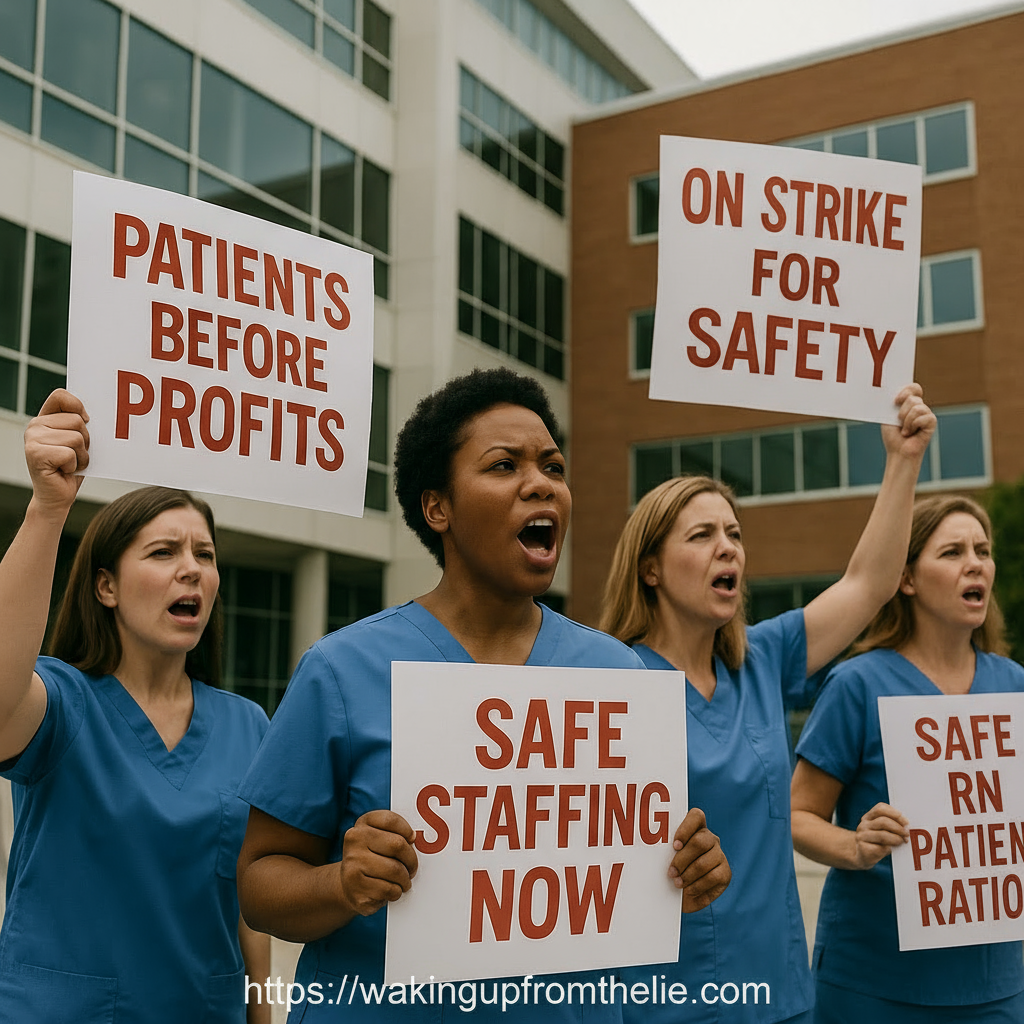
Every time you see nurses outside a hospital holding signs, chanting in unison, or walking the picket line, it’s not because they want to be there.
They are there because they tried everything else.
For months, sometimes years, they have spoken up inside boardrooms and staff meetings, filled out safety reports, sent emails, and begged leadership to listen.
When every plea for better and safer working conditions is ignored, nurses are left with one choice: to stand up publicly for the safety that’s being neglected behind closed doors. Striking becomes the last resort to protect both themselves and their patients.
It’s Not About Money, It’s About Safety
The headlines often frame nursing strikes as “pay disputes,” but that’s a misleading simplification.
Most strikes center on unsafe staffing ratios, unsafe working conditions, violence in the workplace, and burnout levels that endanger patient care.
When one nurse is responsible for eight, ten, twelve patients or more, no one gets the care they deserve.
Every new patient added means less attention for everyone else. Less time, focus, and the ability to give the care each person deserves. With that, the risks climb: missed medications, medication errors, delayed responses, preventable injuries, and overwhelming fatigue.
Nurses know this better than anyone. That’s why they are fighting for safety, dignity, and the chance to give real, meaningful care.
Striking for Patients, Not Against Them
When nurses strike, hospitals must bring in temporary replacement staff. It’s disruptive and expensive, and that’s exactly the point.
The system will not change until it becomes more expensive to ignore the problem than to fix it.
A strike sends a powerful message: Patients deserve better.
Better staffing. Better protection. Better care.
Every picket sign is a promise to patients – “We won’t stop fighting for your safety.”
The Real Crisis Behind the Signs
Across the U.S., nurses face record levels of:
- Burnout: One in three shows signs of severe exhaustion.
- Violence: Up to 82% have been physically assaulted on the job.
- Moral Injury: Being forced to choose between ethics and employer expectations.
These are symptoms of a system in distress.
What the Public Can Do
Nurses can’t fix this alone. Real change desperately needs public understanding and support. Here’s how you can help:
- Listen before judging. Ask why they’re striking.
- Amplify their voices. Share verified information from healthcare unions and advocacy groups.
- Support safe staffing legislation in your state.
- Thank nurses not with pizza, but with policies that protect them.
When you stand with nurses, you’re standing up for the safety of every patient and healthcare provider.
A Closing Note
Strikes aren’t about giving up or walking away from healthcare. They’re about action and walking toward something better.
With the goal of a more compassionate, safer, and humane healthcare system. Where nurses can focus on healing instead of surviving unsafe working conditions.
So the next time you see nurses on the picket line, see it for what it is: an act of care in motion.
See determination, the steady heartbeat of a profession that refuses to give up on care, compassion, and humanity.
Resources & References
Staffing, Safety, and Quality of Care
- National Institutes of Health (NIH): The Impact of Nurse Staffing on Patient and Nurse Outcomes – explains how inadequate staffing leads to missed care, errors, and poorer outcomes.
https://www.ncbi.nlm.nih.gov/books/NBK611041/ - NurseJournal.org: What Happens When Nurses Strike?: outlines the causes and impacts of recent nursing strikes in the U.S.
https://nursejournal.org/articles/what-happens-when-nurses-strike/
Workplace Violence and Burnout
- National Nurses United (2024): Workplace Violence Report: reveals that over 80% of nurses experienced some form of workplace violence in the past year.
https://www.nationalnursesunited.org/sites/default/files/nnu/documents/0224_Workplace_Violence_Report.pdf - American Nurses Association: End Nurse Abuse Initiative: resources and advocacy for preventing workplace violence.
https://www.nursingworld.org/practice-policy/work-environment/wpv/workplace-violence/ - CDC NIOSH Blog (2024): Workplace Violence and Healthcare Worker Mental Health – explores the link between violence, burnout, and trauma among healthcare staff.
https://blogs.cdc.gov/niosh-science-blog/2024/05/29/hcw_violence_mh/
Moral Injury and Systemic Strain
- JAMA Network Open (2024): Nurse Burnout and Quality of Care: evidence showing how chronic stress and moral injury impact both providers and patients.
https://jamanetwork.com/journals/jamanetworkopen/fullarticle/2825639 - AHRQ PSNet: Addressing Workplace Violence and Creating a Safer Workplace: discusses the moral and psychological toll of unsafe conditions.
https://psnet.ahrq.gov/perspective/addressing-workplace-violence-and-creating-safer-workplace
Recent Nurse Strikes and Advocacy
- PBS NewsHour Classroom (2022): Why 15,000 Nurses Went on Strike in Minnesota: explains the roots of one of the largest private healthcare strikes in U.S. history.
https://www.pbs.org/newshour/classroom/daily-news-lessons/2022/09/why-15000-nurses-went-on-strike-in-minnesota - AP News (2025): Kaiser Permanente Workers Walk Out Over Staffing and Pay — recent example of widespread labor action for safer conditions.
https://apnews.com/article/kaiser-permanente-nurses-strike-5bef982ca243921451cf4ad593901fde

fiction health healthcare life love mental-health nursing writing
Leave a Reply